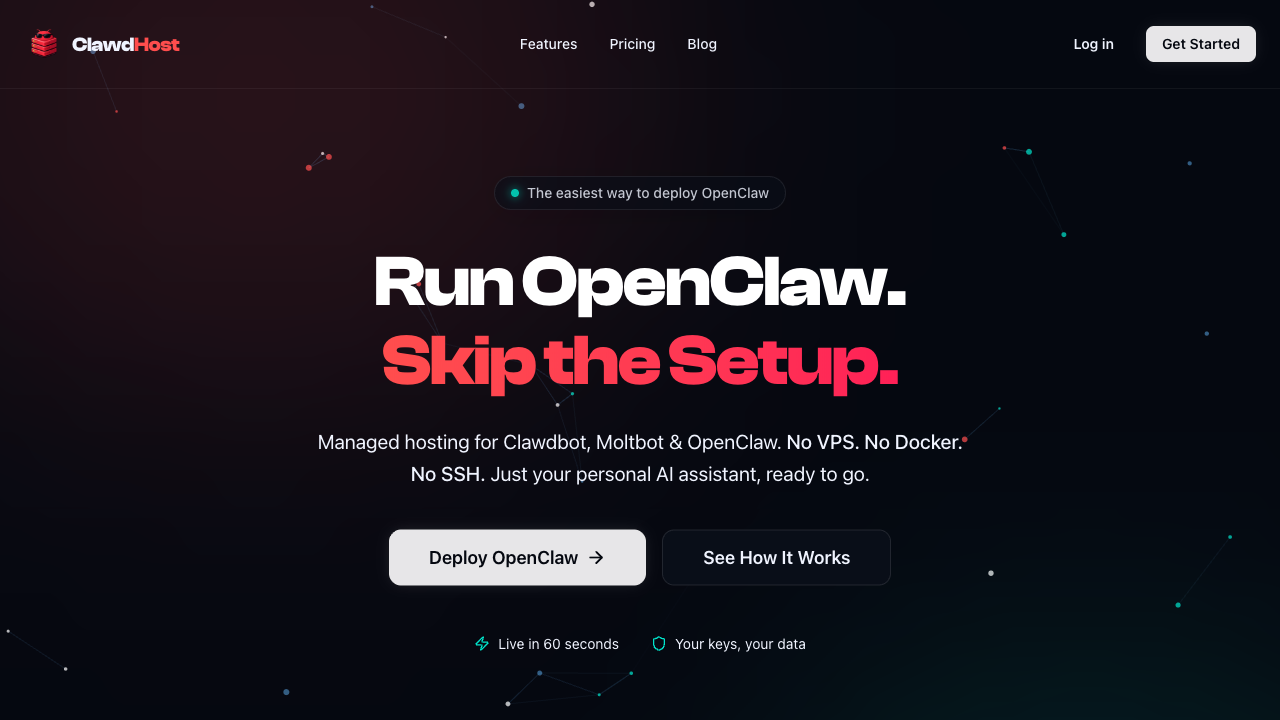
ClawdHost
LivePlaceholder — pending scoring
Security Score: 16.7/100 — Basic
ClawdHost demonstrates above-average transparency for a small OpenClaw hosting provider, with a detailed privacy policy that names specific technologies (AES-256, HMAC-SHA256, Supabase, Hetzner) and a well-written security blog post. The per-user VPS isolation model is architecturally stronger than shared container approaches. However, many security claims remain at the 'Claimed' level — the security blog mentions Vault, sandboxing, audit logging, and Cloudflare protection but these are marketing bullets without supporting documentation or verification. The linked security whitepaper (/security) is a 404. No third-party audits, no MFA, no incident response process, no backup documentation, and no agent guardrails documentation for the managed platform. The provider is transparent about costs and honest about limitations (the DIY vs managed comparison is notably fair), which suggests good faith. Overall security posture: partially documented with specific technical claims but significant gaps in verification, accountability, and agent-specific safety controls.
10 risk categories scored 1-10 × evidence weight. Based on our methodology, grounded in OWASP Agentic Security, NIST CSF 2.0, and CIS Controls.
Privacy policy documents per-user VPS isolation, AES-256 encryption at rest, localhost-bound gateway, and HMAC-SHA256 signed management channel. Claims 'ClawdHost infrastructure is never in the path of your conversations' with a detailed data flow description. However, there is no third-party audit, no mention of employee access controls or audit trails, no explicit statement on AI model training data usage, and no log sanitization documentation. The isolation architecture is well-described but unverified.
The security blog post mentions 'sandboxed execution' and 'allowlist by default' for managed instances but provides no technical specifics about how sandboxing is implemented on managed infrastructure (Docker? gVisor? firecracker?). No documentation of prompt injection defenses, memory integrity protection, or human-in-the-loop controls on the managed platform. The blog's 14-step guide is for self-hosters, not evidence of what ClawdHost itself implements. The claim 'Pre-hardened infrastructure: All 14 security steps configured by default' is marketing without verifiable detail.
Privacy policy specifies 'AES-256 encryption' for API keys at rest. The security blog claims 'API keys stored in Vault, never in plaintext.' The management channel uses 'HMAC-SHA256' signed requests. These are specific named technologies (Documented grade). However, there is no mention of credential rotation, credential leak detection in outputs, least-privilege managed identities, or whether credentials are excluded from AI model context. No documentation on how Vault is configured or who has access.
The security blog claims 'allowlist by default' for managed instances, meaning only specified user IDs can message the bot. The blog discusses command whitelisting and approval workflows but only in the context of self-hosting. No documentation of rate limiting, spending caps, kill switches, behavioral monitoring, or least-privilege enforcement on the managed platform. The homepage mentions 'browser automation baked in' but provides no guardrails documentation for this powerful capability.
Privacy policy states 'your VPS and all associated data are deleted within 24 hours' upon cancellation, and mentions a right to 'export your data.' However, there is no documentation of backup procedures, restore capabilities, data export formats, or how to actually perform an export. The ToS states the service is provided 'AS IS' with no uptime guarantee despite the homepage claiming '99.9% Uptime SLA.' No circuit breakers, no provider stability signals (funding, team size, company age).
Pricing is simple and transparent at $29/month flat rate with a 3-day money-back guarantee. The API costs blog is unusually honest about BYOK cost risks, noting users have received '$500 bills.' The ToS allows price changes with email notification but no defined notice period. No hard spending caps for API usage are documented on the managed platform. The blog mentions 'cost controls enabled by default' and 'usage dashboards' but these are not documented anywhere on the main site.
No incident response process documented. No breach notification timeline. No audit logging documentation beyond a brief marketing claim of 'audit logging' in the security blog. No compliance certifications (SOC 2, ISO 27001, GDPR). ToS governing law section says 'laws of the jurisdiction in which ClawdHost is established' without naming the jurisdiction. No transparency report. The security whitepaper link at /security returns a 404, suggesting either the page was never created or was removed.
No information found about dependency scanning, SBOM, MCP server vetting, build pipeline integrity, or AI provider data policies. The provider uses Supabase, Hetzner, and Dodo Payments as third-party services (listed in privacy policy) but provides no assessment of their security posture. No mention of how OpenClaw updates are validated before auto-deployment to managed instances.
Login page offers email/password, Google OAuth, and Magic Link authentication via Supabase Auth. No MFA option visible. Privacy policy documents 'HMAC-SHA256' signed management channel and 'gateway services bind to localhost only.' The security blog claims 'DDoS protection: Cloudflare in front of all instances.' The site is served over HTTPS. However, no mention of injection prevention, SSRF protection, security headers, or independent security testing. No bug bounty program.
No information found about approval workflows, output verification, undo/rollback capabilities, or transparency about AI uncertainty on the managed platform. The security blog discusses prompt injection as a risk for self-hosters but documents no mitigations implemented by ClawdHost itself. No mention of monitoring for output manipulation or hallucination safeguards.
Key Features
Strengths
Weaknesses
Verdict
Pending assessment